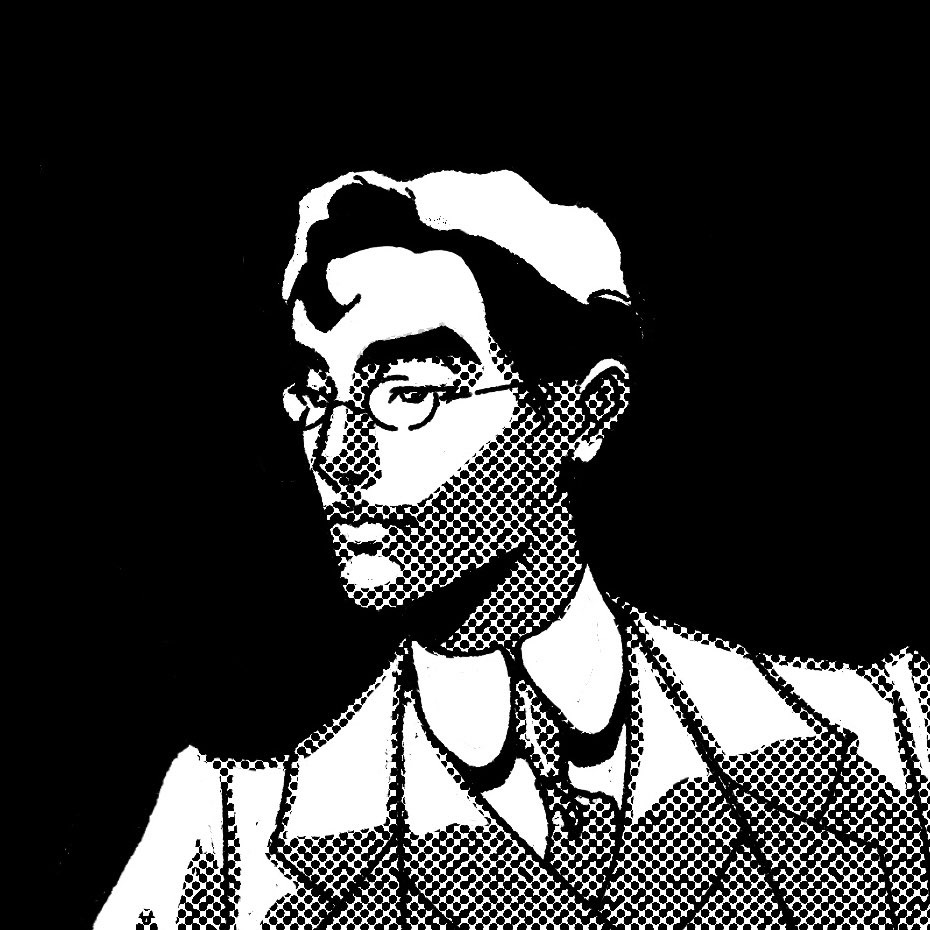
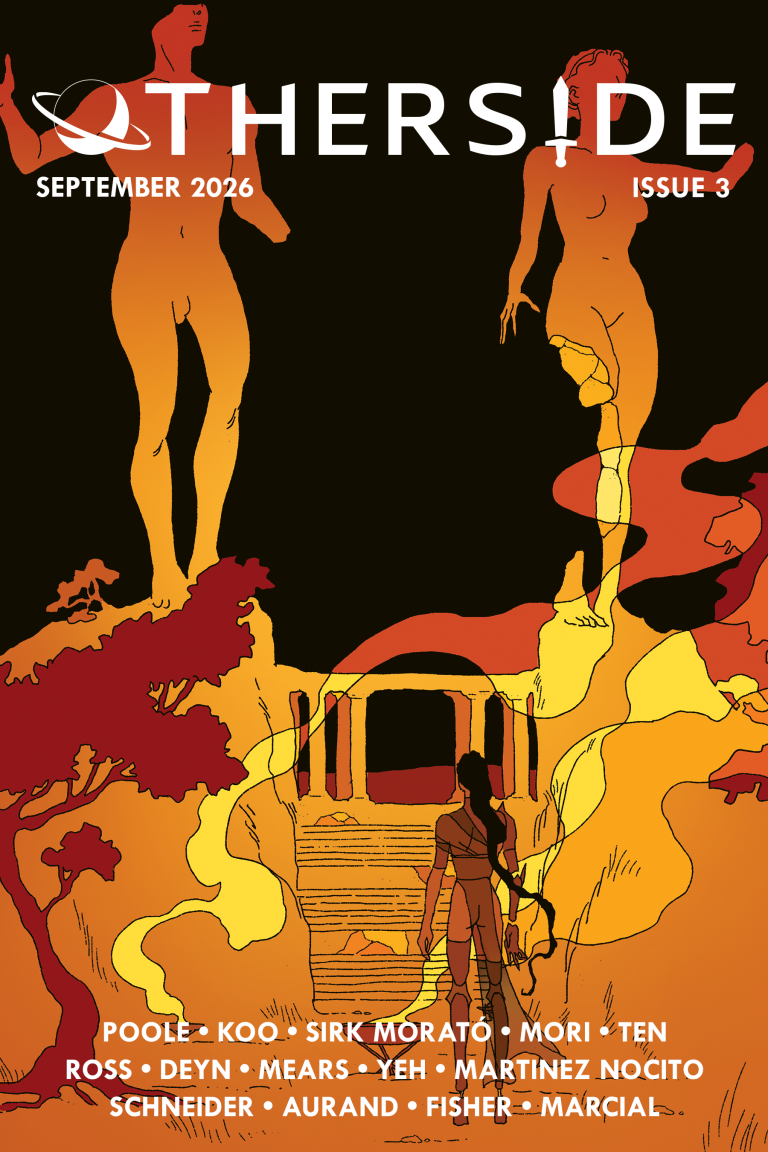

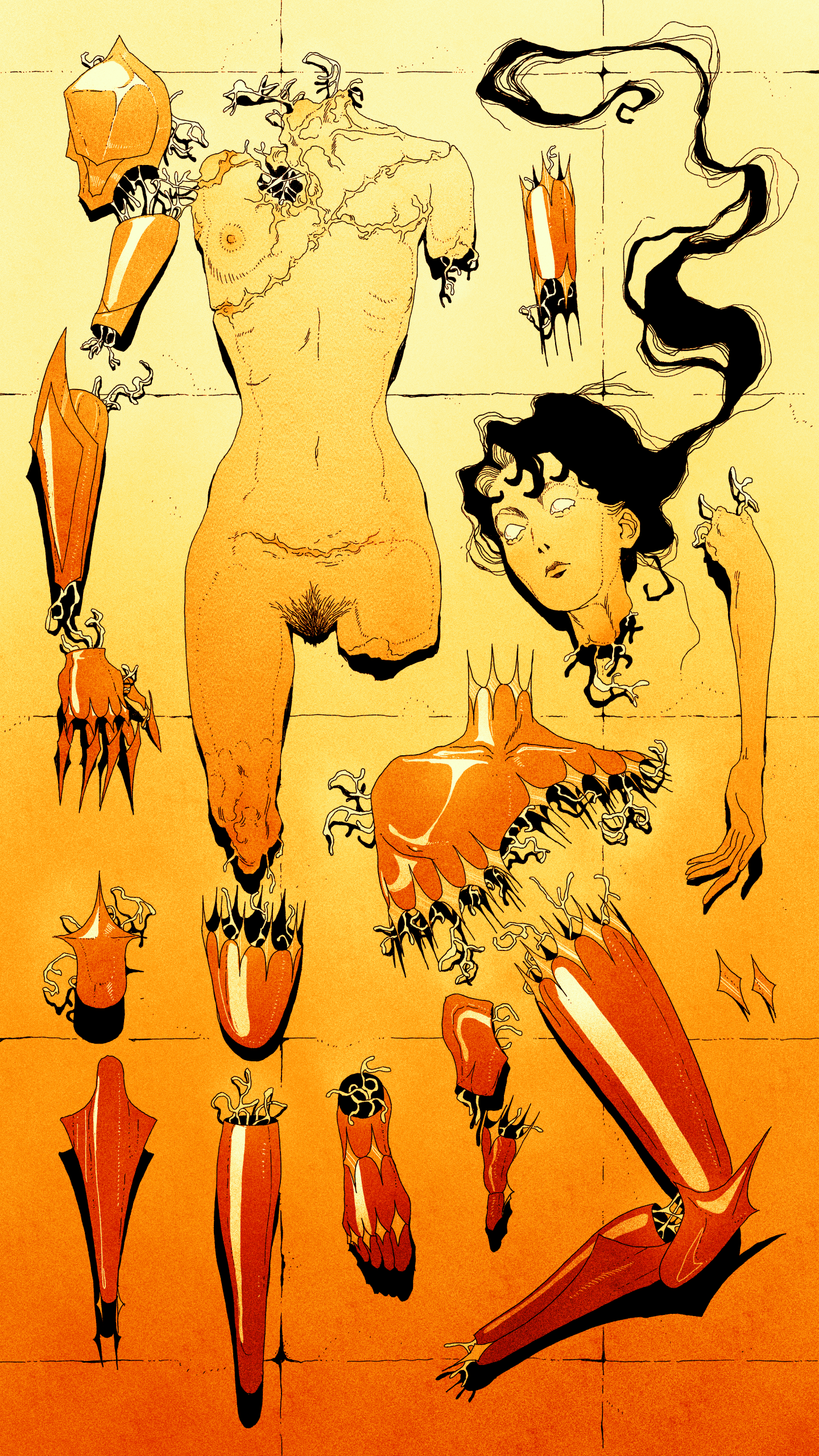
I began visual development of the character pictured in my illustrations for OTHERSIDE in early 2024. His name is Phaeiné (Φαεινή), Fên for short, after the feminine Homeric form of the adjective phanós (φανός): gleaming, radiant; splendid. But his language is not Homer’s. The tradition which molded him outshines itself. He is the child of another sun-heavy, dusty playground for gods, where mythologies separate fiction from reality, art from object, as skin separates the body from air. In the worlds which he trespasses, the direction and weight of the light signify day and night without resolution; the idols are defaced but nameless; in the muck of the southwestern corner sits an abandoned toilet. These worlds cannot hold him for long, nor can he cling to them, vacuous as they are, no longer fit for habitation human or otherwise. Fên’s gender is irrelevant. His womb is inoperable. Thin lines along his silhouette just visible at the viewer’s discreet distance articulate the chinks in the armor, the self and unself. He is all metal and all flesh, an impossibility of interior and exterior, made as he is unmade. The hero is fated to rot: light replaces him (fig. 1).
When did language erode into brightness? Several centuries after Homer, the poet Ovid wrote epic hexameters in Latin. He includes in his Metamorphoses a brief and violent account of the punishment of Marsyas, a satyr of the east and original player of the Greek flute. Marsyas was an unhappy medium for the vanity of gods: Minerva’s flute became his because to play it was to disfigure her face. For the satyr’s pride in his skill, Apollo flayed him alive. The Ovid opens with the repentant satyr’s cry: Quid me mihi detrahis? Why do you tear me from myself?
The question Marsyas asks of Apollo is the question he asks of us. Am I less myself when torn? The poet provides no answer, instead inviting you to look for yourself.
clamanti cutis est summos direpta per artus
nec quicquam nisi vulnus erat; cruor undique manat,
detectique patent nervi, trepidaeque sine ulla
pelle micant venae; salientia viscera possis
et perlucentes numerare in pectore fibras.
as he cries out, skin is ripped from the surface of his extremities
and there is nothing left of him but wound: blood streams from all sides,
the sinews gape open, and quivering without any
hide the veins gleam; you could count the leaping organs
and the glittering filaments in his breast.1
A speculative world resides in this possis. You could: you, reader; you, baleful god. You are alone with Marsyas and his shining interior, revealed in the passive voice by a god barely present. With little context and few other bodies to orient yourself, you wonder if Marsyas is in fact addressing you, though you look on in voyeuristic silence as the image gasps and fades. There stands between the viewer and Marsyas a portal of flesh. Should you begin to pass through—should you even imagine articulating the organs—you yourself may begin to show signs of radiance.
Ovid’s ecphrastic register has spawned centuries of interpretation. The Italian painter Titian’s representation of Marsyas is crowded with bodies human and divine, mythological and animal, but not too many to count. Marsyas himself, still intact, distracts from his own myth. The arm of his punisher may be his arm; the bodies which surround him may be his bodies, his organs. Titian’s painting distinguishes one figure from another, but the mass of flesh remains troubled by articulation. The composition relies on the vee of Marsyas’s black legs to make sense of the scene, though these legs are also the branches of the tree to which he is tied. The darkness of his lower body flows north like a map of a river delta. What is the source of light? Not one among the congregation pretends to know, each preoccupied with their role in the violence. But there is brightness everywhere, brightness of the skin, of the pale body of the lira da braccio, of light glancing from each of the two knives, from Apollo’s golden hair, from Midas’s diadem and robe, from the hardware of the bucket. And in the deep valley of his suffering, Marsyas’s right eye, looking at us (fig. 2).

Art makes demands of the body. Often in too much pain to think, I’ve drawn my pictures in the cruciform-laden house of my dying grandfather, in desolate canyons of Texas and California, in the car, on a plane, in bed. I’ve lent texture to my linework with a hand trembling from medication-induced mineral deficiencies as my interior surfaces concatenate. How long until I’m only a long, bare chain? How much of the body is enough? By the artist’s sleight of hand, the viewer can see only so much. I must master both signs and delay. The stroke of the pen brightens what’s ahead while only ever shading what’s passed. The trick is not the making of inside outside or outside in, but of pure surface. This is a sad safety but not a lonely one. Queer, sure, that’s in the magazine description. Suffering, yes, though its language is not always sufficient. But always the darkness, darkness of the skin, which belongs to me until the moment it does not.
The body of Marsyas—indeed, the body of Ovid’s poem, which served as the influential account for the European tradition to which Titian’s painting belongs—is a racial artifact.2 Ours is a question of reception; that the fathers of America preferred Roman republican prose to Augustan poetry is moot. The racial artifact legitimizes; a photograph of a formerly enslaved man’s scarred back confronts the viewer with incontrovertible evidence. Evidence of what? The white man’s capacity for violence? The humanity of the Black subject? Here, again, suffering is not enough.

There is a truth which Marsyas and Fên, in each of whom abounds the first person, do not share with Peter: the fact in fiction, the reality of body. Search for Marsyas in the scholarship and you find accounts remarkable only for their colorblindness: “The narrator clearly prefers the satyr with the skin off.”3 Marsyas the spectacle, Marsyas the arena. Is he space or is he body? Academics are helpless and titillated. Marsyas, “two for the price of one.” Marsyas, “a low grade of humanity.” Marsyas, “an animal whose flogging or flaying would provide an appropriate public punishment.”4 The business of flaying skin—of skin itself—drips as a heavy gore from the English language. What, indeed, does the narrator prefer? It is a violent thing to wonder. In the introduction to the essays collected in Nobody Knows My Name, James Baldwin reminds us that skin stands but not on its own.5 Color makes the barrier between myself and me. When this barrier comes down—for Baldwin this was leaving America for Europe—there is nothing left but threshold. The revelation of an interior is a strange privilege. Baldwin writes, “One can only face in others what one can face in oneself.” When I think of Peter I see his face first—is he turning towards me or away?—and then his hand. His thumbnail blinks at me like an eye. Its shape is just like my father’s.
Last year I won a diagnosis—and a spot off the surgery waitlist—for the gynecologic condition which has been ruining my body for over a decade. Pyrrhic, of course, for the obvious reasons. Why the delay? It was not my queerness that posed the obstacle, no matter how desperately I wanted it to be. That was something the legion of white women to whom I am privileged to entrust my care might understand. Maybe if I looked more like my brothers, with their prominent noses and glossy hair. No such luck. My skin betrays me. I may be in more danger as a man in broad day than as a woman at night, depending on where I walk. The light shows all the pores, exposed and glistening like open mouths.
Scar tissue is the truth of augmentation. Marsyas is first a satyr, then a speaker, then all wound. Each transformation is proliferative, though not without loss; we witness not the satyr’s flute but the satyr’s cries, not the body but the gore, the viscera, the veins. In this cascade, the blood of Marsyas becomes the weeping of his brethren, and this wetness the river that flows in his name:
fertilis inmaduit madefactaque terra caducas
concepit lacrimas ac venit perbibit imis;
quas ubi fecit aquam, vacuas emisit in auras.
inde petens rapidus ripis declivibus aequor
Marsya nomen habet, Phrygia liquidissimus amnis.
the fertile earth was drenched, and wet she gathered the fallen
tears and drank them deep into her veins;
when she changed them to water she released them into the open air.
From there a river hurrying quickly along downhill banks to the sea
holds the name Marsyas, the brightest river in Phrygia.6
The body liquefies as it moves through pain. Even as a river Marsyas cannot outrun his own erotics. This is the queer fantasy, the cripple’s fantasy, and inevitably too a racial one. How much pleasure might Marsyas have felt were he my shade? My mistake: my fantasy.
There is a lyric voice hiding here beneath the epic one. Monica Youn has beaten me to it with her 2023 collection From From—a play on the white interrogator’s “where are you from from?”—in which resides a poem titled “Marsyas, After.” It begins:
Dust loves me now, along with
leaflets, plastic bags, anything
unattached, anything looking
for somewhere to stop, something
to emblazon.7
Everywhere are impressions of Ovid: the excesses so tightly controlled, the bright darting of the gaze which comes to fall, endlessly and always, on the body. But Youn’s poem is prone to redundancy; these lines precede another eighteen couplets which teeter between the twin evils of righteous and maudlin, unsure how to make sense of the suffering which felt at the moment of injury to span oceans and centuries. “Marsyas, After” ruminates in one direction and the next (“I float in my tub / of blood-warm water; element / of indecision”), deploys disdain for the white other with a disingenuous third-person plural (“I could be / like them if I chose”; “their marmoreal self- / regard”), and alights occasionally on some brightness (“I stain everything / I touch, it all stains me”) or form (“my raw surface is an unlidded eye”) without reattaching itself to the textures of its opening lines. I shrink from the pages as I shrink from the thin and familiar soup of Asian-American diaspora literature knowing well that my own project is not far off. But what project? Assimilation or rejection? Youn and I invoke the name of Marsyas and are stripped of our ability to choose. To either assimilate or to reject involves some kind of contact, whether an adhesion or a sloughing. I am attracted to the chafe. Moving with intention is difficult when the surface upon which you move is too slick to create friction.
Anish Kapoor’s Marsyas, a 150-meter structure of red polyvinyl chloride built for a 2002 exhibition at the Tate Modern’s Turbine Hall, is an exercise in this paradox of contact. The artist himself describes the installation as having “an emphatic kind of intimacy.”8 Marsyas is both intentional and disturbing, though not always simultaneously. Though Kapoor claims disinterest in scale itself, Marsyas’s size urges you to reject and to assimilate from a tactile distance rather than a visual one. As in the case of Ovid, Kapoor’s project is confrontation. The structure’s glamor is all artifice; it refuses to tell too much. Its central wide mouth serves as its subjunctive. “Form is never enough,” Kapoor reminds us. “It is the way it comes to have meaning that is the issue.”9 The artist desires the audience to feel that your creative imagination is expansive, that together you might apprehend one long, taut sinew of a Marsyas who could be more than a hundred stories tall, a shrapnel of suffering larger than life, evidence of fantasy. In the absence of photographs here, due both to Kapoor’s infamous stringency of copyright and the impossibility of conveying Marsyas’s shape and scale through a camera lens, consider the language used by structural engineer Cecil Balmond to describe the project:
SKINNING THE IMAGINATION
As a 28m-diameter hole sucks you in, the circle pulls away and climbs up rapidly, narrowing, the seams of the fabric move onto a small passageway high on the cusp of a sweeping curve. That red orifice, like a throat, swallows the eye and squeezes it past into a vanishing. As the visitor escapes the suction and runs into the Turbine Hall the story unfolds of an arch that leaps and dips down to hover threateningly over a far land of the mezzanine. Again, a gaping hole is the only horizon. This time is it mouth or giant ear? Another arch leaps from the platform to come down on the other side towards earth, foreshortened, flaring into a circle as a mighty steel ring pulls it down and tensions the fabric. Through the open passageways, flying arcs and saturated colours, another force stretches our preconceptions and startles us with intense pictures. Something tough and resolute yet deeply disturbing pulls at our minds. Somewhere between memory and what we see, a hidden structure acts on our emotions with phantoms that shape visceral feelings. Nothing can be talked about, only felt. The imagination is exposed—raw, vibrant. Here at Tate Modern, with Anish Kapoor’s work, preconceptions are stretched and warped into altogether another reality.10
If you have never seen this work before, whether in person or in an image, I urge you to conjure a visualization from the words on this page. For a structure which is neither architectural nor interactive, interior nor exterior, both audience and engineer are compelled to rely on the second person to explain Marsyas in language. The poet’s efforts are impotent without you to hole-punch the page. Flesh stands at a distance between you and the you that you see.
My brother has never seen my surgical photographs, so he doesn’t know just how many gleaming filaments were needed to adhere my internal organs to one another, but he has seen the exhibition catalogue for Marsyas, which he describes as endometrial. That’s a little obvious, he warns me, though his observation does not stand alone. Marsyas is a feat of metonymy. There is something fraternal about the self. I am separated from my brother by skin. A double layer, in fact: his and mine. We communicate in connective tissue instead of mirrors, though the flesh may shine as glass does. To have a brother is to be a brother—Fên is one, though you may have never seen him. Part of the body stands for the body, between the body and itself. Apprehending Marsyas beside my brother, I find it remarkably literal. Abstraction serves as distraction; the spectacle is the point. But only during surgery can you see what’s inside. I like to imagine Turbine Hall in total darkness, Marsyas stretching its quiet and childless length from one side of the beast’s belly to the other.
Balmond frames Ovid’s ecphrasis as advertisement on an industrial scale. Both he and curator Donna De Salvo recognize Marsyas as a project of the twenty-first century that could not have been conceptualized or built prior to the advent of computer engineering and digital modeling. This is context, massive and ugly. Somewhere within the steel rings and diagrams, the mechanical and the abstract, is Kapoor’s mythology of objects: things which are made and not made; things which make themselves. He calls this way of thinking “Indian”;11 to what does his India refer? In her introductory essay to the work, De Salvo references, in a single sentence at the end of a paragraph, Kapoor’s “notions of Hinduism and mysticism.”12 James Baldwin, too, is concerned with this form of aberration, this excess, this mystique. For him, the white imitation of culture is a mimetic assimilation which contains within it a rejection: “Since this mystique depended on a total rejection of life, and insisted on the fulfilment of an infantile dream of love, the mystique could only be extended into violence.”13 There is something of the fetish in the mystique, and Kapoor is conscious of its power. “The form, I insist,” says Kapoor, “made itself.” A delightful mysticism, perhaps, to the white consciousness. But for many of us, self-making is one of two options:
…to become a Negro man, let alone a Negro artist, one had to make oneself up as one went along. This had to be done in the not-at-all-metaphorical teeth of the world’s determination to destroy you. The world had prepared no place for you, and if the world had its way, no place would ever exist. Now, this is true for everyone, but, in the case of a Negro, this truth is absolutely naked: if he deludes himself about it, he will die.14
The structure of Baldwin’s “you” is encompassing but not assimilative: he is concerned less with exterior and interior and more with the chafe. The mystique is a failure of representation, an occlusion of the second person, of the nakedness of the flesh.
Kapoor makes conversation with the human subject rather than representing it. In his interview with De Salvo he confesses he has not worked with figure directly since he was a student. But he agrees that the figure is implied, that it is inescapable. His forms are no less racialized for their abstraction. “Revealing a racial marker in a poem is like revealing a gun in a story or like revealing a nipple in a dance,” writes Monica Youn.15 Representation wants to know, Where does Marsyas come from? What is Marsyas about? Marsyas wants to know, Why do you tear me from myself? The relationship between the form and the idea is not so pungent as place nor so free as association: even the mystical has a body, a mouth, a voice to communicate with.
Here is a portal: language. Much like skin and its “implied unreality”—Kapoor’s words—the second person is a double. Fên stands alone on some threshold, looking away from the viewer, not only perceived but perceiving. But he is not a photograph; he is hardly a representation. At his most potent he may be something like a brother. On the page he is only a system of lines created by the swinging of my hand. He can only move when we move; when a “me” generates a “you.” Implied or extant? True or unreal? Self or other? Between me and myself: you. I guarantee there is no mystique. The speculative world is a semiotic trick. Peek behind the curtain and you may find shining entrails indistinguishable to the naked eye from your own. Lord, writes James Baldwin,
I
am beneath that water.
It falls with great force
and the light
Blinds
me to the light.16

NOTES
- Ovid, Metamorphoses (Loeb Classical Library 42, 1916), 6.387-391. English translation my own. ↩︎
- Ken Dowden, “Marsyas (1), satyr” (2016), in Oxford Classical Dictionary, ed. Lucy Grig (Oxford Academic, 2015). ↩︎
- Andrew Feldherr, “Flaying the Other,” Arethusa 37, no. 1 (2004): 82. ↩︎
- Paula James, “Marsyas’s Musical Body: The Poetics of Mutilation and Reflection in Ovid’s Metamorphic Martyrs,” in Arethusa 37 (Johns Hopkins University Press, 2004), 92. ↩︎
- James Baldwin, Nobody Knows My Name (The Dial Press, 1961), xi. ↩︎
- Ovid, Metamorphoses, 6.391-400. English translation my own. ↩︎
- Monica Youn, “Marsyas, After,” in From From (Graywolf Press, 2023), 11. ↩︎
- Anish Kapoor, Donna De Salvo, “A Conversation: Anish Kapoor with Donna De Salvo,” in Anish Kapoor: Marsyas (Tate Publishing, 2002), 63. ↩︎
- Kapoor, De Salvo, “A Conversation: Anish Kapoor with Donna De Salvo,” 61. ↩︎
- Cecil Balmond, “Skinning the Imagination,” in Anish Kapoor: Marsyas (Tate Publishing, 2002), 69. ↩︎
- Kapoor, De Salvo, “A Conversation: Anish Kapoor with Donna De Salvo, 61. ↩︎
- Donna De Salvo, “Making Marsyas,” in Anish Kapoor: Marsyas (Tate Publishing, 2002), 16. ↩︎
- James Baldwin, “The Black Boy Looks at the White Boy,” in Nobody Knows My Name (The Dial Press, 1961), 229. ↩︎
- Baldwin, “The Black Boy Looks at the White Boy,” 232. ↩︎
- Monica Youn, “Study of Two Figures: Pasiphaë / Sado,” in From From, 3. ↩︎
- James Baldwin, “Untitled,” in Jimmy’s Blues and Other Poems (Beacon Press, 2014), 91. ↩︎
Copyright © 2026 by
Theo Marcial