It’s an incredible time to be a fan of speculative literature. There are dozens of wonderful, volunteer-run magazines working tirelessly to publish fantastic work; there are more and more great stories and poems being published every day, many of them available online, completely free to read. This is astounding: infinite wonder on demand.
But… it’s a hard time for those of us who care about great stories, too. Earlier this summer, following a report from Bona Books, it became clear that many (many!) publications had unknowingly published AI-generated stories by the same “author.” It also quickly became clear that this problem was bigger than just one scammer. The industry has an AI problem. Or, rather, we have at least two AI problems. Editors are being bombarded with slop at an unsustainable rate—and sometimes the slop is being published, too. If you’re anything like us, you’ve been thinking a lot about this situation. As writers, it’s discouraging knowing that every publication of an AI-generated story represents an opportunity stolen from somebody else. As editors, it is, frankly, beyond exhausting to even have to think about any of this, much less deal with it in our inboxes on a daily basis.
So, this month’s editorial felt like a good time to reiterate our AI policy. To put it in the most formal language possible, fuck this shit forever. We do not want to see any work knowingly planned, generated, or revised in whole or part by LLMs. Crucially, too, this expectation goes both ways: we promise our authors that we will never knowingly use AI in our process. This slop is a plague upon our field. It’s not enough to say we don’t want these submissions because they’re “bad.” They are bad. They’re a layer of painted papier-mâché atop something hollow and bloated and rotten. They are, at best, statistically average, which is the worst thing a story can be. But as far as we’re concerned, quality is irrelevant. There’s no universe in which we would read a generated story and think, “huh, this is pretty good,time to rethink our policies.” The thing we care about—the only thing that matters—is human creativity itself. We want your desire and your shame and your passion and your joy and your rage. We want your roughest edges. We want the stories only you could write.
As editors, we are responsible for what we publish. That’s the bottom line. We aren’t ever going to ask an author to perform a dozen somersaults, recite their work from memory while standing on one foot, and/or send us a minimum of thirty-seven rough drafts. And, given our focus on supporting queer creators, we are certainly not interested in forcing people to “prove” their identities. So, what are we going to do, then? We’re going to read submissions carefully, talk about them, think about them, and publish work we’re proud to stand behind. We’ll keep doing everything we can to stay on top of this technology, and we’ll work closely with trusted colleagues at other publications, sharing everything we learn. Still, we can’t swear that we’ll never make a mistake. We are badly outnumbered by scammers and slopmongers, and technology is evolving rapidly. All we can promise is that we will never waver in our convictions and, if we do screw up, we will act decisively. We stand for human art, always.
It’s a hard time. And it’s an incredible time. Publishing is difficult. There are members of our team working dozens of unpaid hours a week—on top of demanding jobs and family obligations—to bring you each issue of OTHERSIDE, and very few of those hours are spent on the fun parts. We are wading through slop, squinting at spreadsheets, and enduring the dread nightmare that is marketing. But… we love it. We love what we do, more than we can ever say. Reading submissions makes us happy. Championing authors makes us happy. And sharing their work with you, our readers, makes us happiest of all. We’re excited to share this issue. It includes nine stories, four poems, and one essay, almost 30,000 words by queer authors from around the world—and we’re carrying on our streak of publishing at least one debut author in every issue, too! These pieces explore devotion and duty; they’re hungry and desperate. They ask what it means to create something beautiful, to be transformed by pain or love or both. And, above all else, they remind us that art is worth fighting for.
The poems of Issue 3 are sometimes tender like an embrace and sometimes tender like a wound. The issue opens with Madeleine Poole’s “Feral thing in a lightbox,” a bloody fairy tale about gender, want, and the girl in the wolf’s belly. Arda Mori’s “The Clay King” is both creation myth and love poem, bittersweet and beautiful. In “trans/formative,” Nico Martinez Nocito wonders what it might mean to unmake our bodies and create something new instead. And, lastly, Kym Deyn’s spectacularly titled “Tiktaalik Rosae, or, If We Were the Earliest Example of a Link Between Fish and Tetrapods Would You Climb onto the Mudflats with Me?” is the most romantic poem about lobe-finned fish you will read today (or ever).
The fiction in this issue, meanwhile, is fantastically intense. In “One Floor, One Phoenix,” a story almost impossible to describe without spoilers, Crystal Koo examines the ugly intersections of technology and shame. Mina Yeh’s heartbreaking and hopeful “Field Notes on Liturgical Rites, Co-Authored Li and Albrecht” insists that love can work miracles, literally. RJ Aurand’s “This Is Not a Place of Honor” combines vampires, vikings, and nuclear semiotics… and blurs the lines between inquiry and obsession. Kristina Ten’s “Ivan Ivanovich” will make you fall in love with a spacecraft test dummy. “The Illuminated World” by Rebecca Schneider is this issue’s shortest story, soft and candle-lit; it’s also a worldbuilding masterclass. In “His Face, in the End, Inches from Mine,” Elijah J. Mears offers readers another rich fantasy world, but you might not have time to admire the details, because you’ll be too busy crying. Last but not least, Cyrus Amelia Fisher’s “Wine-Dark” is a lush study of guilt and grief—and a story in which navigating an ocean populated by massive, ravenous leviathans is still easier than navigating family.
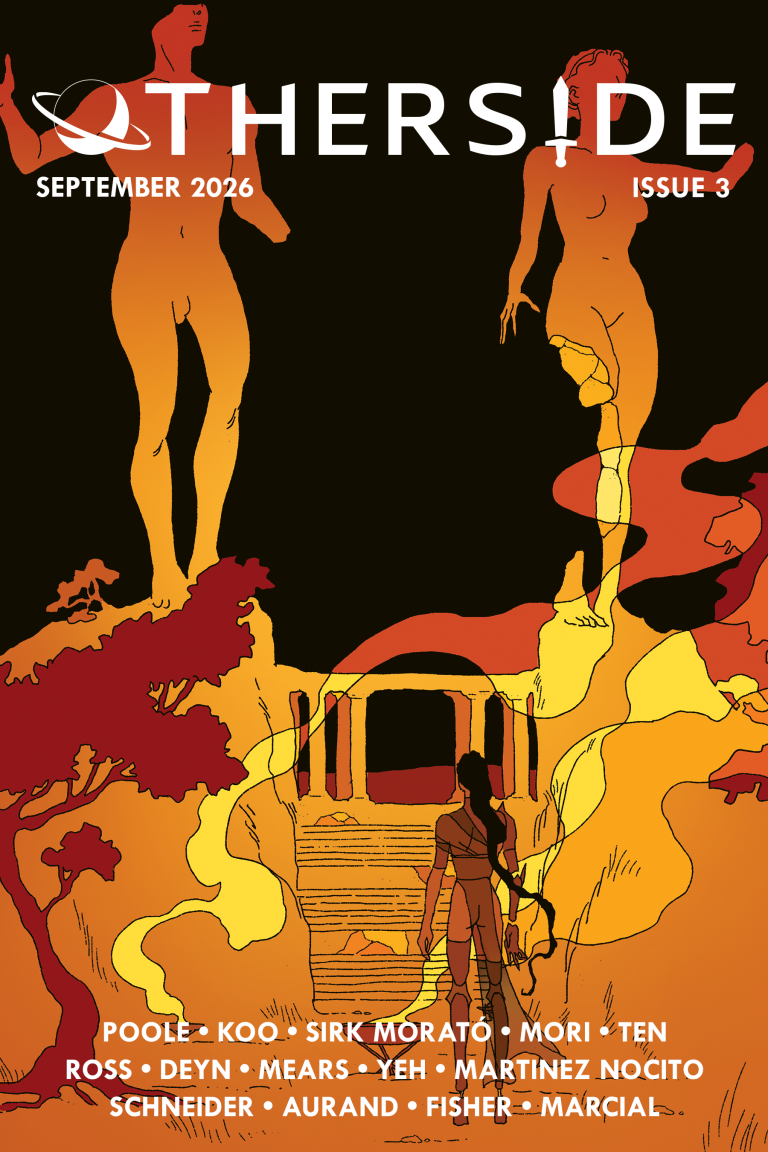
On top of that, we’re excited to reprint two fantastic stories you can’t currently find anywhere else online. Samir Sirk Morató’s “BLIGHT” is a wrenching, layered examination of an Appalachian community and their neighbors: a grove of dying chestnut trees. And, just in time for all your Halloween reading needs, Algae Ross’s “The Monster at the End of this Film” is a love letter to monster movies and final girls. Lastly, this issue’s nonfiction selection—“Why do you tear me from myself?”—is special. Theo Marcial, our Year 1 artist, has written an essay about (in part) the figure pictured on each OTHERSIDE cover, featuring new art, too. It’s also an exquisite interrogation of myth, violence, art, and the body.
We love these pieces and we hope you will too. If you enjoy this issue, please share it with a friend or consider sharing the link online. Word of mouth is everything! If you aren’t already a subscriber, you can join us at www.patreon.com/othersidespec for as little as $2/month, which comes with behind-the-scenes content and perks like Discord access, merch discounts, and more. You can even pick up a print subscription! Thank you, all of you, for everything.
Enjoy this issue, othersiders. And please keep making incredible, strange, messy, wonderful, human art.
Gratefully,
Ash, MR, and Val
Copyright © 2026 by
OTHERSIDE