
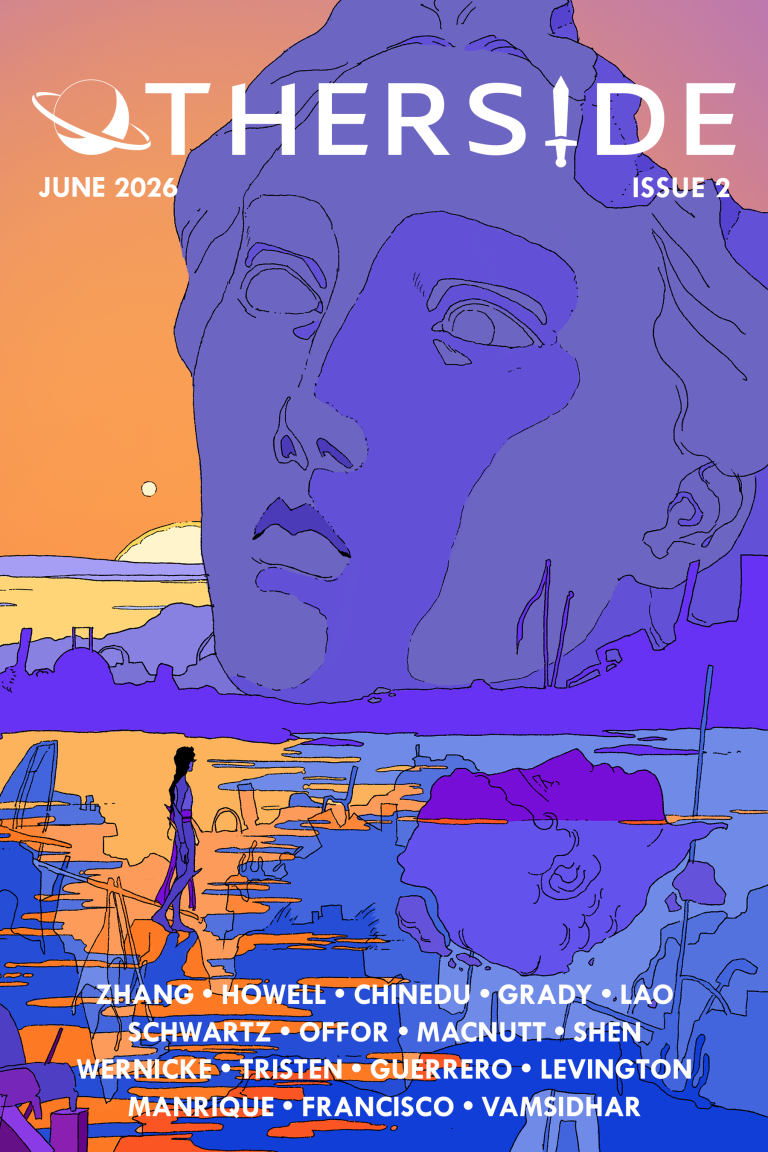

Damnatio memoriae: Latin for “condemnation of memory.” In ancient Rome, the practice was used against the most powerful—emperors could be torn from history just as easily as they could be torn from earth. Statues would be defaced and refaced, coins destroyed and names meticulously scrubbed from the record. Ripped, cut, scraped away, as if they were never here. A great and terrible punishment for a culture obsessed with reputation, though it has never been exclusive to the ancient world. My most irrational fear is that someone will deem me important enough to erase from the record of existence. This is a fate far darker than death.
One Roman victim survives in the histories—not by chance or miracle or his own persevering strength of character, but because someone wanted him there. Cassius Dio, a historian and contemporary of his, used a variety of epithets to put him down on record, taking care to avoid the ban on his name: False Antoninus, the Assyrian, Sardanapalus. His birth name (Varius Avitus Bassianus), his regnal name (Marcus Aurelius Antoninus), and even the common posthumous nickname of Elagabalus were all unspeakable. He was a Syrian youth of fourteen, the shimmering male hope of an ambitious family, a child with a role to play. His mother was cousin to the emperor Caracalla, and when the emperor was murdered by a former aide who promptly claimed the throne for himself, she saw opportunity in the mayhem. After encouraging a rumor that her young son had been fathered by Caracalla to strengthen the familial claim, she left Syria with an army and took Rome. Another emperor is murdered, and the center of power shifts to a boy from one of the empire’s most far-flung territories, his only qualifications being accidents of birth. Women could play the convoluted games of men, so long as there was a male to place in the vacuums they created.
There’s no reason to believe the young emperor wanted to be in this position. He fit strangely within it, and if he had any ambition at all, it wasn’t worldly. Back home, he had served as high priest of the Arab-Roman sun god Elagabalus, his association with the deity so tight that he would come to be known by the god’s own name. Elagabalus (the boy) brought Elagabalus (the god) with him to Rome, housing his sacred cult stone in a temple there. The senate would watch him dance around it. Herodian, another contemporary of the boy’s, wrote that he insisted on dressing in a flamboyant, distinctly Eastern fashion: jewels and tiaras and rich purple robes. Dio wrote that he would dance as he walked. To picture “Rome” is to picture marble and metal, roads cutting straight through hilly countryside, hard lines and hard men. It is difficult to imagine something soft, something edgeless that melts and floats and threatens to take more space than allotted. Stricter societies take great pains to snuff such things out. Eventually, Elagabalus named his foreign god chief deity of Rome, usurping the sky god Jupiter himself—the empire was to worship the sun over the very heavens.

Around the Mediterranean, the sun feels closer to earth, as if you could stretch up and char your fingers on it. On my first day in Athens, I climbed a small mountain in sandals and a sundress to see an ancient grave and came down an angry red, scorched—I’d gotten much too close. A week later, I sat with my eyes screwed shut as a tattoo needle passed over my still-healing burn, tracing little olive branches on my collarbone. I had met the artist two days earlier and thought he was cute. This was all it took to allow myself to be permanently marked. He spoke very minimal English to make up for my very minimal Greek, and he did not apologize when he accidentally groped me, but I wouldn’t have wanted him to. I chose the spot because I thought it was sexy: highly visible, highly painful, draws attention to the chest. Some strain of insanity took over me in Greece, like I was waking up suddenly to my body and had only a limited time to experience all that it had to offer. Whether this looming deadline was my flight back to Chicago four weeks later or something else, I had no idea, but nobody knew me there and that made me want to go crazy, to come back different or not at all.
I had spent all of my previous twenty-three years on Earth confined within the borders of the United States, rarely more than a few miles away from family, and now I was outside and alone. Who could I be, if not restricted to the role of American girl, Midwestern girl, my mother’s daughter? I didn’t feel much like a real person back home, just an assortment of predetermined shapes. Even this—American girl goes to Greece to find herself—is just a cliché, even when partying on the islands is swapped out for stalking ruins on the mainland. But there is so much power in new scenery, in the shock of sensation. I went to dinner that night with the student group I was traveling with, still nagged by the warm, prickly sting of a fresh tattoo brushing against fabric with every movement. The restaurant owner brought the whole table shots of ouzo on the house—nasty stuff that tastes stronger than it is, and half the group declined. I took the rejects, downing them all before an audience of amused and mildly horrified half-strangers. It was like swallowing fire.
Dio accused Elagabalus of using his body “for both doing and allowing many strange things.” Don’t we all? But Dio also described a boy just on the cusp of manhood plucking hairs from his chin, working the brothels of Rome with a wig on, offering wealth and boundless gratitude to any physician who would be willing and able to craft a vagina on his body. This was a special sort of strange. He didn’t want what was given to him. After the first time I ever bound my chest flat at eighteen, I didn’t do it again for ages. Inexplicably, I felt guilty—ungrateful, perhaps, or something of the sort. My body was bent towards one specific role, and for that purpose, it was quite well-suited. One of my mother’s go-to forms of praise was to express jealousy over my C-cups, and friends fantasized about what they would wear if they looked like me. Men would tell me I had a gift, a trump card that could be strategically revealed for sympathy or free drinks. What a waste to hide that away. And occasionally people stared at my flat chest with a sort of low-burning revulsion, like all of their effort was trained on figuring me out and they were unraveling over the fact that they could not. But a year after returning from Athens, I started to bind again. This time, I didn’t stop. It hurt sometimes, squeezing my back and chest and leaving my ribs sore. It covered my tattoo. But I couldn’t stop.
So much of transition feels like sin, like breaking a precious thing on purpose. Like renovations—you can bust down the bedroom wall and rebuild it somewhere else, shrink or grow the space within. But for a time, everything protected within is left vulnerable. You’re still sleeping there while the wall is down. While I was no stranger to more subtle forms of self-harm, I had never intentionally caused myself to bleed before I first began hormone replacement therapy. The nurse warned me that a gradual push into the skin would hurt more, prolong the piercing, so I overcompensated the first few times and slammed the needle in, leaving myself bruised at the injection site for weeks. But even as I learned to manage that balance between hard and soft, I always bled, just a bit, like a reminder that this was injury, the tiny spots of dried blood on all of my clothes little artifacts of self-inflicted damage. I began to think ahead to all the ripping and cutting and scraping away I wanted to do to myself, each motion leaving a new scar. But the rush of testosterone let me feel like a person: present and living and responsive and so full of desire to eat or touch or fuck everything I laid eyes on. Hate that disguises itself as concern often refers to transition as self-harm, and maybe by some definitions it is. But I would carve and butcher the body that prevented this kind of life a hundred times over—if this is destruction, so is the sculptor taking their hammer and chisel to the clean block of marble. And I suppose that may be the case. Maybe there are things better off demolished, overthrown, left to ruin.
Some said that Elagabalus wanted to be referred to as a lady. Dio, at least, used feminine pronouns and called the emperor a woman. This was certainly not a show of respect. Rather, it was an insult. To an ancient Roman, a woman was a terrible thing to be. To be born a woman would afford you some pity, at least, because your deplorable nature could not be helped. But for a man to display womanly traits—to be sentimental, cowardly, sexually submissive to other men—he must be truly disturbed. It was a grievous moral failure, a cause for disgust. These attitudes remain at the roots of modern transmisogyny: to willingly adopt the role of the inferior class is to be fundamentally untrustworthy. This gendered language, if affirming, was only affirming by accident. Modern historians do not tend to use feminine language at all, erring on the side of strict factual accuracy over any romantic notions of healing historical wounds. And who’s to say that such a thing would even be called for? Nothing is left of Elagabalus but unsympathetic words—the words of men who decided that removal from the historical record was not punishment enough, men so eager to smear this person’s name that they would override damnatio memoriae and revive or preserve their memory just to violate it. Can we conceive of a whole human with rights and desires from these materials? Can we reconstruct something with the very tools used to destroy it?
History is written by the victors is an old cliché but the primary concerns of looking into the past have never been said more effectively. The phrase speaks to two essential truths: that history is not a thing that happens but a thing that is written, and that access to the record is unevenly distributed. Power grants access, and in this way, power begets power: the surviving accounts of victory grant continued victories on the battlefields of forever. When the powerful understand the function of the written word in their struggle, they know they must both suppress and produce. What you read of an event centuries after the fact has likely landed on your desk because the victors allowed it. Even the most well-meaning historian, a true champion of the oppressed, cannot recover what has been destroyed or prevented from existing. They may point out the gaps and the biases and suggest an alternative narrative, but these particular wounds never scab over and there is no salve to heal the ache of a gaping hole in the past that will never be closed. The violation repeats each time a child reaches back for answers and finds none. Mutilation of the historical record is a perpetual injury, a fissure branching into eternity. It is Prometheus chained to a rock—the curse of regeneration. It is an act of cosmic violence.
There are ways that historians can—and do—address the gaps left in the stories of the marginalized with care and generosity. Elagabalus has been referred to mostly as a man, but not always, and there are historical justifications for either approach. But ultimately, the historian bears the responsibility of justification. They must carefully toe the line between trust and skepticism towards their sources, always willing to accept an unsolvable mystery lest they fall to the temptation to fill in blanks too haphazardly. But I am not a historian. I want to call Elagabalus a woman because it feels good to do so. Cultural context casts doubt over the whole thing—the Roman tradition was to paint their enemies as incestuous, cross-dressing sex pests, and the impulse to feminize the East was so inherent to their worldview that it seems almost subconscious in much of their writing—but the specifics of her story are unusual, too precise for me to believe they were invented. She isn’t just wearing a dress and sleeping with men; she is expressing a deep and familiar anxiety towards her body and her social roles. Her perceived maleness got her into the most powerful position in the world, and it seems all she wanted was to use that money and influence to become a girl.
The sources were either sharing genuine anecdotes that revealed the emperor’s deplorable nature or inventing them to skew her image that way, but it only works if the audience finds the behaviors deplorable. She married a Vestal Virgin, a priestess sworn to celibacy on pain of death, such an egregious act of blasphemy that I can only conclude that it was an act of aggression rather than ambivalence towards the rules. She presented her mother and grandmother with senatorial positions, opening the Senate to women for the very first time. She wanted to, and possibly did, marry at least one man. The trans menace is one of the greatest threats to a harshly patriarchal system: women occupying men’s roles, men occupying women’s. Our mere existence is anarchy; it is a matter of destroy or be destroyed. I imagine Elagabalus a girl all along, slinking into a position of immense, unfettered male power under the ruse of her body’s shape, and opening the floodgates. This may or may not have been her truth, but it is a story I am choosing.
As my transition progressed, I eventually began to hate feeling things so fully. Depressed or not, I have always been just curious enough to stay alive, but I had never before faced a world filled with such malice toward the very idea of me. Was it better to be unknown than to have the whole world frothing at the mouth over us? I thought of how I’d want to be found. I thought of how cathartic it would be to write the note—I would have to make it beautiful, something worth saving. I was more upset about the idea of someone tossing my words in the trash than I was about the idea of being dead. It’s an impossible place to be: there are times when I cannot fathom being allowed to live like I am, but I could never imagine going back. Exit can seem like the only sound option. Recently published numbers on the trans community make it clear that this is an alarmingly common feeling. Forty percent attempt suicide; eighty percent report seriously considering it. Hauntingly high as these statistics are, they do not account for those who are no longer alive to be surveyed. These facts, rather than stirring sympathy, have become ammunition—to be a trans person on certain corners of the internet is to see your comment sections exposed to chants of forty percent, forty percent, a taunt with plausible deniability. But we know what it means. They won’t have to kill us if we keep doing it for them.
One source says it had been prophesied that Elagabalus would die a violent death, so she fashioned tools with which to do it herself when the time came: golden swords, emeralds filled with poison, a gilded tower from which she could throw herself, a noose of purple and scarlet silk. She reversed the threat—you won’t get to kill me if I do it myself. And she imagined that if she had to go, it wouldn’t have to be some hideous way. She could make her death magnificent, matching the opulent violence of her unexpected, perhaps unwanted, empire.
But this sort of bravery in the face of death is a lot to ask of someone who is, ultimately, a child. In the end, she would die running. She was deeply unpopular—too foreign, too different, too hostile to Roman ways. At eighteen years old, just four years into her reign, she was chased by her own guard into the arms of her mother. Their bodies, naked and headless, were dragged through the city streets before Elagabalus was flung unceremoniously into the Tiber River. Damnatio memoriae was enforced, her god removed from the top spot of the pantheon, women once again barred from the Senate. It was as if she had never been there. In a popular but unlikely story, she once arranged for masses of violets to fall from the ceiling during a banquet, like something out of a dream. Several of her guests were smothered to death with flower petals. If nothing else is, I hope this story is true.
Mediterranean means “middle land” or “inland.” The sea is surrounded on all sides by lands that were home to empires too big to contain themselves, kings and pharaohs and emperors who tried to create gods of themselves and sometimes got close. Several years into my transition, I found myself on the other side of the Atlantic again, drawn back to this place where the sun feels immediate and dangerous, like a predator breathing hot down the back of your neck. Rome in July during a global heat wave felt unsupportive of life, and yet it breathed, an energetic communion between the living and dead, between ruin and new creation. I was running through birth and death dates in my head as I walked the streets, trying to match my vision to the vision of someone long-gone and famous. Was this building here when Cleopatra made her trip from Alexandria? Was this part of Michelangelo’s view when he climbed down from Vatican Hill, his neck sore from a day of staring at the ceiling?
I regret that Elagabalus did not cross my mind until I crossed the Tiber. It always comes back to our deaths, doesn’t it? I could only imagine this scene from the point of view of the onlooker—what, when her body was thrown into the water, did the city behind her look like? She should be more than that, but it is the way of things—we exist too far outside the long line of tradition to be more than background noise to the historical narrative most of the time. The movers of the world move it from within. There is a surviving bust of her face in the Musei Capitolini, in that Roman style that approaches realism but departs before the eyes, always just slightly uncanny. It is unsettling how young she looks—full-lipped and baby-cheeked, an adolescent wisp of a mustache adorning an otherwise bare face. I sense a teenage apathy in her expression; I can picture the lanky limbs and awkward posture extending past the limits of the sculpture. She should never have been here, but would she be happy to know that, despite all that effort to remove her, she remains?The first time I swam in the Mediterranean, it was noon; the sea was still frigid, but the sunlight shattered into glitter on the waves like broken glass. The Romans called this water Mare Nostrum: Our Sea. It is where the Tiber empties. I wonder—do her bones still rest there? I waded in far enough that my feet left the sand. I had never gotten over the way ocean water lifts and carries you as it moves, and I let it carry me for a while. It was silent save for the gentle splashing of calm waters. All I thought of was drowning there.
Copyright © 2026 by
Sidney Grady