

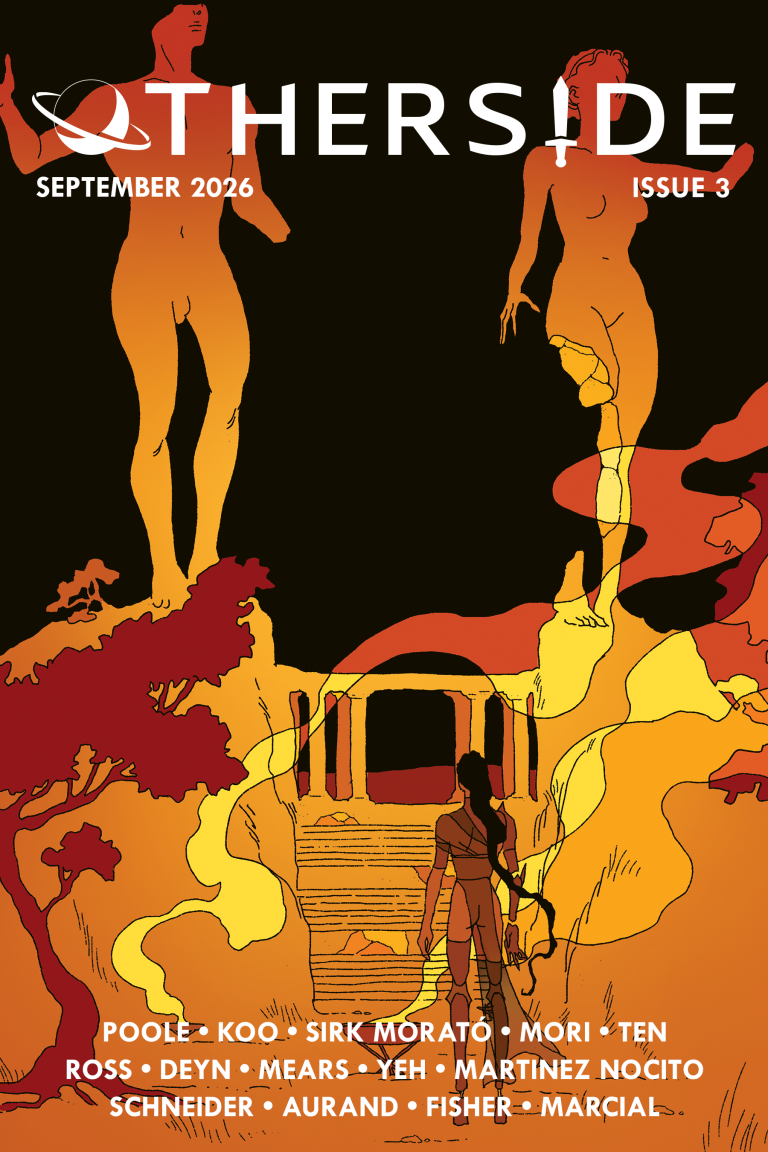

The partially petrified remains of the last living vampire lie preserved on an island at the top of the world, under the watchful eye of the midnight sun.
Little is known about her save what survives through legend. Stories passed down through the centuries tell of the killing of her brethren: how they were stripped bare and marched to the rocky edge of the sea, skewered to stone with iron spikes and left to await the dawn. Those remains are inert, the ones that haven’t yet crumbled indistinguishable from statues except for the agony on their faces, and even that will weather away with time. But she—she fled north, seeking sanctuary in endless night.

The boat skims across dark water, scattering the ribbons of aurora reflected in its surface. You stand at the prow, wind stinging your eyes, holding tight to the strap of the backpack that contains your research notes and clothing for the next three days. The other passengers huddle together as they chat animatedly over the sound of the motor. Most are on this excursion courtesy of a travel adventure program. You are the only solo traveler among them—an oddity, apparently, in these parts.
As you squint into the darkness, faint rays of purple collect at the vanishing point. Dawn, you think, before you remember that at this latitude it will be weeks before the sun crests the horizon.
You grip the railing as the glow blooms ever brighter.
The saga of the hero Einar Light-Bringer tells of the pursuit of a monster in the sunless wastes, of the lives she drank and the devastation she left behind her. Enveloped in darkness, she thought herself safe. But she hungered fiercely, and in time her pain drove her to the place where Einar and his men lay waiting. And Einar, unbeknownst to her, had been gifted by the god Baldr a miniature sun. When he pulled it from his pocket, it dispelled the darkness and turned her to stone.
Most surviving texts end there, preferring to present the legend as a victory. They make no mention of the six she felled before the light struck her, including Einar’s only son. They do not describe how Einar wept as he cut the still-warm heart from his child’s chest and it petrified in his hands.
When the hunting party did not return, men from the village set out to recover them. They found Einar there, frozen in the snow, heart in one hand and sun in the other.
And of the vampire, they say only that she was called Millarca, and that when the men found her, her heart was still beating.
Einar Light-Bringer’s people constructed barriers around her, concentric rings of sharpened stone to ward off those who would approach while leaving her resting place open to the sky. Anthropologists generally consider this to be one of the earliest human attempts at hostile architecture, strikingly similar to designs proposed under modern nuclear semiotics. Runes carved into larger stones that mark each of the cardinal directions read: Let death lie sleeping.
You wrote your dissertation on the tale of Einar Light-Bringer, using it to speculate on other works of vampire literature through the ages. You argued that the myth of Perseus and Medusa was in fact a vampire tale, corrupted by centuries of oral tradition until its details had reversed polarity. You were not the first to make this claim, but that didn’t make your argument any more popular with the other folklorists in your department. If you had contained your research to Scandinavia, you might have had an easier time with your defense—but on the other hand, you remind yourself, vampires didn’t spring into being in northern Europe fully formed. Stone remains have been unearthed everywhere from China’s Hunan Province to the coast of Ghana, some so weathered they were initially mistaken for stalagmites, others preserved in such sharp detail they still look as if they were carved yesterday.
None of them living. In that aspect, she is peerless.
The island receives few visitors during the dark half of the year. You disembark alongside two Irish retirees on their sunset tour of the globe. The couple wanders into the spike field, hand in thick-gloved hand, walking the perimeter at a leisurely pace. You nod to the armed guard at the landing and cut straight to the center, the harsh glow guiding you through the polar night, to her.
Einar’s miniature sun still shone at the center of the maze when the site was rediscovered in the 1960s, providing insurance against Millarca’s awakening during the dark months. Upon discovering that the material was radioactive, the team studying Millarca replaced it with banks of ultraviolet lights to make the site safer for human researchers.
In time, the grave of the last vampire became a tourist attraction for those wealthy enough to make the pilgrimage and brave enough to withstand the cold. They wander through the labyrinth to take pictures with Millarca, to lay their heads on her chest and listen to the rhythm of her beating heart. Her grimacing visage graces mugs and t-shirts, album covers and tattooed skin.
Each year upon the first descent into polar night, the Daughters of Millarca hold a vigil for her and make offerings of incense and wine. Some bleed themselves in her honor. They are not allowed to approach her in this state, but the stones that mark her grave bear the stains of many who wished to slake her thousand-year thirst.
The stone circle is larger than you imagined it. Even the smallest of the spikes towers over you. As your boots crunch through the thin crust of ice, you are overcome by a quiet sense of awe. The scale of this place. The dramatic shadows cast by the light radiating through the stones. The mournful sound of the wind whistling through the gaps. The way it tugs at your coat.
The spikes fall away with a suddenness that makes your breath catch. Millarca lies silhouetted no more than fifty meters from you, a tiny aberration in a pristine circle of tundra. The lights framing her emit a violet hue that sends pain searing through your eyes even as you lift your arm to shield them.
The wind goes silent.
She lies recumbent, like an odalisque in a painting. If she had been sculpted, there’s no doubt that her pose would be considered scandalous. The splay of her legs. Her arm extended as if in invitation. Her back arched, breast heaving toward the sky. Her head tipped back so her stone eyes regard the viewer as they approach.
You imagine you can hear it already—the beating of her heart, stronger and steadier than the erratic thumping in your own chest. Not for the first time, you wonder what she must have felt in those final moments. Did she harbor hatred for Einar Light-Bringer and his people? Regret that she hadn’t managed to take all of them with her? Or was she relieved, perhaps, that her struggle was over? What did it feel like, to know she was the last of her kind?
Millarca was human once. You’ve yet to find another scholar more interested in the woman she was than the monster she became.
While the safeguards keeping Millarca in stasis have proven effective thus far, the risk remains that in the absence of artificial sunlight the living portion of her remains could regenerate, reversing the petrification of her exposed flesh. The damage an awakened Millarca could do is difficult to predict; vampires have not been a threat to humanity in living memory, and much of what was once common knowledge has been lost to time.
Still, the regenerative properties of vampiric tissue hold promise for treating cancer and degenerative neurological conditions. It is highly probable that organic brain matter still exists inside Millarca’s stone skull. A small sample, endlessly replicating, could potentially save thousands. Yet after one disastrous and highly controversial attempt to probe the inside of her head, the possibility was put aside. The procedure was aborted not because of any fault with the equipment but because Millarca’s heart had begun to beat so rapidly and with such force that it was audible from more than five meters away, even over the sound of the drill.
“It was like she was screaming,” lead researcher Sven Ahlgren said, visibly shaken, when asked about the incident in an interview with the BBC later that year. “And I started to wonder if maybe we were the monsters.”
You met the man at a conference last year, and there was something hollow about his expression as he shook your hand, like the experience took something from him he never got back. You found yourself pitying him, and yet you were nearly sick with jealousy. To have had the opportunity to examine Millarca so closely, so unfettered, was a privilege you could only have dreamed of—until now.
With gloved fingers you caress her face, scrape a thin coat of rime from her cheek. Stone lashes prick from her eyelids. The pores in her nose are filled with ice. Every tooth is sharpened to a point. She looks as if at any moment she could gasp and rise, shaking the frost from her hair.
Like a thousand tourists before you, you lay your head on her breast, using your scarf to protect your skin from freezing to her silvered armor, communing with the drumming of her immortal heart. Is she aware of the passage of time? Would waking, for her, be like surfacing from a long, deep dream?
You’ve lingered too long.
“Unnskyld?” The guard addresses you in Norwegian, his breath hanging suspended as if frozen in the violet light. He waves a rifle-mounted flashlight at you. “Trenger du hjelp?”
“I’m a researcher,” you say, sitting back on your heels, cheeks smarting from the cold as you fumble for your university ID. “I’m expected.”
“You should have checked in at the outpost first,” he replies, switching smoothly to English. “Normal visitors are not permitted to loiter.”
You nod and apologize, sheepish at having misstepped, although you fail to see what harm you could do in the face of the measures keeping Millarca in stasis. If it were that easy for her to break free, surely she would have done so by now.
“I’ll just be here for a little while, listening to her heart. I’ll check in afterward. Is that all right?”
He stares at you for a moment, clearly measuring your potential as a threat, and then lowers his rifle. “Researchers are expected to follow protocol, or they will be asked to leave. There will be no further exceptions.”
“I understand.” You fold your hands in your lap and wait until he marches away, the crunching of ice beneath his boots swallowed up by night as he exits the circle.
You lay your palm on Millarca’s chest, wondering what lies beneath. Perhaps her torso is flesh, smooth and supple despite the ages, clinging to life even as a thousand freezes and thaws send fractures spiderwebbing across her exposed face. Or perhaps it’s something more liminal, a mottled crust of flesh and stone that grows ever more rigid as the material protecting it degrades. It’s possible that with enough time, Millarca’s body will fully petrify. The thought fills you with grief, although you could never live long enough to see it happen.
Unaccustomed to the cold, you recognize that you’ll need to retreat to the outpost soon. But for now you just look at her, taking in as much detail as you can. She’s around your height, maybe a couple of inches taller. Although the stories of Einar’s people describe her as feral and beyond reason, her hair is woven into intricate braids that coil where they meet the ground. You trace them with your hands. She cared for herself, or was cared for, even after she ceased to be human.
Cradling her face, you look into her dull stone eyes. Her snarl is often painted as one of fury, but now, alone with her under a sky salted with stars, your face mere inches from hers, you don’t see anger in her expression.
Only fear.
The Irish couple are long gone, returned to the mainland along with the boat. With the island free of visitors—save for you—the guards and scientists who protect and maintain the site have retreated to the warmth of the outpost, drinking and playing cards as they eat steaming bowls of stew prepared by the resident archaeologist. She gave you the first helping, a kindness that endeared her to you immediately.
All the same, there’s something disquieting about listening to them rib each other and laugh and sing and ready themselves for sleep while Millarca lies on her perpetual deathbed less than a kilometer away. You are pervaded by the sense of having left someone behind, an anxiety that itches at the nape of your neck as you do your best to settle into bed.
“I know that look,” the archaeologist says, squeezing your shoulder as she passes by your bunk. “Don’t worry—you get used to it.”
You nod and mumble your thanks, although you don’t really believe her. Your concern for Millarca stems from somewhere deeper than your brain: a base, animal part of you that understands that being left behind means death. Despite the petrification, you realize, despite the long, thin teeth that fill her mouth like needles, you can’t help but think of her as human.
Your head pounds all evening. You chalk this abnormality up to the Arctic weather at first, but as you lie awake staring at the ceiling of your bunk, it intensifies until the rhythm resolves into one you recognize.
A heartbeat.
You awaken on the second day disoriented by the harsh arrival of artificial dawn in the crew quarters. Outside, wind howls past in inky blackness. Your body fights to reconcile the two, momentarily latching on to the purple glow on the horizon before you realize with a jolt that the light is emanating from the site, not the sun. You exist, for the moment, outside of time.
Millarca awaits you unchanged, which fills you with a strange mixture of relief and disappointment. You understand intellectually that she isn’t alive in the same way that you are. And yet somehow you expected—perhaps even hoped—to find something different.
You spend the morning making detailed notes on her features, particularly the careful plaiting of her tresses and the craftsmanship of her tarnished breastplate. These are not the marks of a creature devoid of reason. They are tangible proof of her sapience. Crouching in the snow beside her, you imagine the agony of constant war between a body determined to regenerate itself and an onslaught of poisonous light.
Disheartened, you retreat to the outpost. You expected this trip to be transformative. The culmination of years of research, the seed of a paper that would come to define your career. Instead, you feel ill. In your head Millarca was larger than life, but in person her petrified form is painfully small and vulnerable.
A boat arrives while you’re licking your wounds over a cup of warm broth. You return to the maze to find it littered with people who wander the spikes at a leisurely pace, marveling at the juxtaposition of Viking-age stonework and modern electronics.
A cluster of silhouettes congregate at the center, surrounding Millarca’s recumbent form. The harsh light washes out their details, so it takes you a moment to understand what you’re seeing: a young man and his friends, laughing as they take photographs. One of them straddles Millarca so her hand is pressed against his crotch.
“What are you doing?” you shout, your voice tight in your throat.
They turn, sizing you up. You are wearing a coat that identifies you as staff, loaned to you after it became apparent that your own cold weather gear was inadequate, but it is sized for a man and hangs loosely from your frame. You don’t have a rifle to brandish, or even a flashlight.
“Relax,” says the one leaning over her, rolling his eyes. “It’s just a joke.”
“Holger!” you cry, hoping to summon the guard and his piercing stare, but the wind swallows your words. They turn away and resume their desecration, taking turns grinning for the camera.
Feeling sick, you run to find someone—anyone—who can put a stop to this, but by the time you return the boys are gone. There’s nothing to be done.
You kneel in the snow beside Millarca and softly lay your head on her chest, thinking of sculptures with breasts and asses rubbed to a brilliant luster by irreverent hands just like theirs.
Her heart beats steadily beneath you.
You take long, deep breaths of the frigid polar air until yours slows to match it.
After the boat departs, Holger conscripts you to take part in the security sweep. Despite his surly demeanor, you think he might actually feel a little bad for you. Giving you a task so you can feel useful is probably his way of trying to console you after this afternoon’s breakdown.
You don’t have a gun, but you are issued a heavy metal flashlight. Holger pairs you with the archaeologist, whose name you still can’t pronounce correctly despite her patient attempts to coach you. The two of you hike toward the landing while the rest of the research team checks the perimeter.
“This is kind of overkill, isn’t it?” you say as you trudge through the ice. “You count everybody, right?”
The island is small, and you can see the beams of the others’ flashlights as they walk along the opposite shore, even from here. The outpost juts from the ice, cold and severe. The only other thing that stands more than a couple of feet off the ground is the stone circle itself.
The archaeologist grimaces. “It may seem that way. But a few years ago someone did manage to hide when the boat left. Eiríkur told me they found him climbing the UV array. So now we always check.”
You turn that over in your head while she radios in that the landing is clear. You imagine the invader’s movements as he crept into the circle’s harsh light. What was his goal?
The radio squawks back, and the archaeologist nods. “Okay, now we move inward.”
All around the island, the crew steps toward the circle.
You sweep your flashlight back and forth as you walk, but the play of light and shadow tricks your eyes into fabricating movement. The stones regard you impassively. Rust-colored stains drip down some of them, and as you brush your fingers against the discolorations in the low light, you wonder if the roughness you feel through your gloves is lichen or the crust of old blood. The Daughters of Millarca held their vigil for the long night only weeks ago. You privately think of this practice as farcical. It’s clear to you that Millarca—the real Millarca—had no worshippers, and indeed, at the end, no companions at all.
The circle grows denser until at last you stand on its precipice. As you emerge from the shadows, half a dozen flashlights blink back at you—the rest of the research team, converging on the maze’s center.
Your breath catches in your throat, and in a flash you understand. You are the hunters in the sunless wastes. You are Einar Light-Bringer, stalking a killer through the freezing dark. You are the son whose lifeblood will stain the snow before you can raise a hand in your own defense.
You are Millarca, maddened by loneliness, pursued to exhaustion by men whose only goal is your destruction.
You stand over her with the others, waiting while Holger and Eiríkur check the integrity of the UV array, head throbbing from the light. Millarca grimaces up at you, primal fear forever frozen in her stony visage. The others chat and huddle together for warmth as you stand pinned by her gaze.
Holger returns and dismisses everyone to the outpost. He places a gloved hand on your arm. “You as well. You’ll feel better if you keep regular hours.”
You nod slowly but can’t bring yourself to move.
“Come along.” Sighing, he puts his arm around your shoulders, herding you back toward the squat, distant silhouette of the outpost. As you cross the boundary of the circle together, he glances back at the dark shape in the snow.
“Sov i ro, Millarca.”
The light refuses to leave your eyes. Your head aches through dinner—a violently red borscht stinging with vinegar. As you bite into a fleshy chunk of beet you suddenly picture Einar Light-Bringer, tears freezing to his face as he cups his son’s heart in his hands, and your stomach turns sour. The pounding in your head intensifies.
It continues through the evening, persisting as you excuse yourself to bed early and then fail to find relief in sleep. Even after the rest of the research team succumbs, you lie awake, imagining yourself immured in ice, the unforgiving sky whirling overhead.
Amid a chorus of snores and murmurs, you slip out of bed and pull on your boots.
The trudge to the stone circle feels twice as long as it did a few hours ago. Above, the aurora coruscates from verdant green to deep crimson, reaching down tendrils that probe the artificial violet nova and then recoil.
You enter the field of thorns.
Millarca’s heartbeat grows louder with every step, pressing on your eardrums until they threaten to burst. You understand now what Ahlgren meant when he said that she was screaming. How could anyone possibly be asleep at the outpost right now?
The absence of any physical change is what frightens you most when you reach her. Psychic keening crashes over you in waves. You can’t hear her—you can’t hear anything over the deafening thud of her heartbeat—but her anguish is so severe that it almost brings you to your knees. Surely the stone encasing her should be cracking. Surely some of the spikes should fall.
Helpless, you drop to your knees at her side. You clasp her outstretched hand, but it cannot grasp back. You can do nothing, nothing, nothing, to make the screaming stop. Tears stream from your eyes. The light is blinding.
The specter of the stowaway materializes in your mind, sprinting toward the UV array, and at once, you understand.
On hands and knees you drag yourself toward it, eyes shut tight to spare them damage. As you slip around the back the light falls away with an abruptness that prompts you to sob. You feel it. You feel her burning. You feel her dying on a cellular level, every second of every minute of every hour.
You can be the one to end it.
The thick cable that powers the lights runs to generators underground near the outpost, buried several feet deep to avoid unwanted interference. But it emerges from the ice just feet from you, and though your eyes burn with afterimages, you think you see where it can be disconnected.
Your gloves can’t find purchase on the cable, so you tear them off and attack it barehanded, your exposed skin sticking to the metal fittings. It splits as you pull and you wail, only aware of the sound because you feel it tearing from your throat.
Everything else is Millarca.
Your blood smears black under the violet light as you twist and yank with shredded fingers. When the cable finally gives, it sends you tumbling backward onto the ice.
The lights flicker, and the world plunges into darkness.
The screaming stops.
The heartbeat in your ears is your own now, echoing against boundless silence. Cautiously, you get to your feet. You try to feel your way back to Millarca and trip over her in the darkness, sprawling out in the snow. Blind and bloodied, you reach out for her hand.
Panicked shouting carries across the tundra from the outpost. When they reach you, they will shoot you for what you’ve done, but they can only cover the distance so quickly. For a few precious minutes, at least, it’s just you and Millarca, alone in the night.
You hope that will be enough.
Copyright © 2026 by
RJ Aurand