

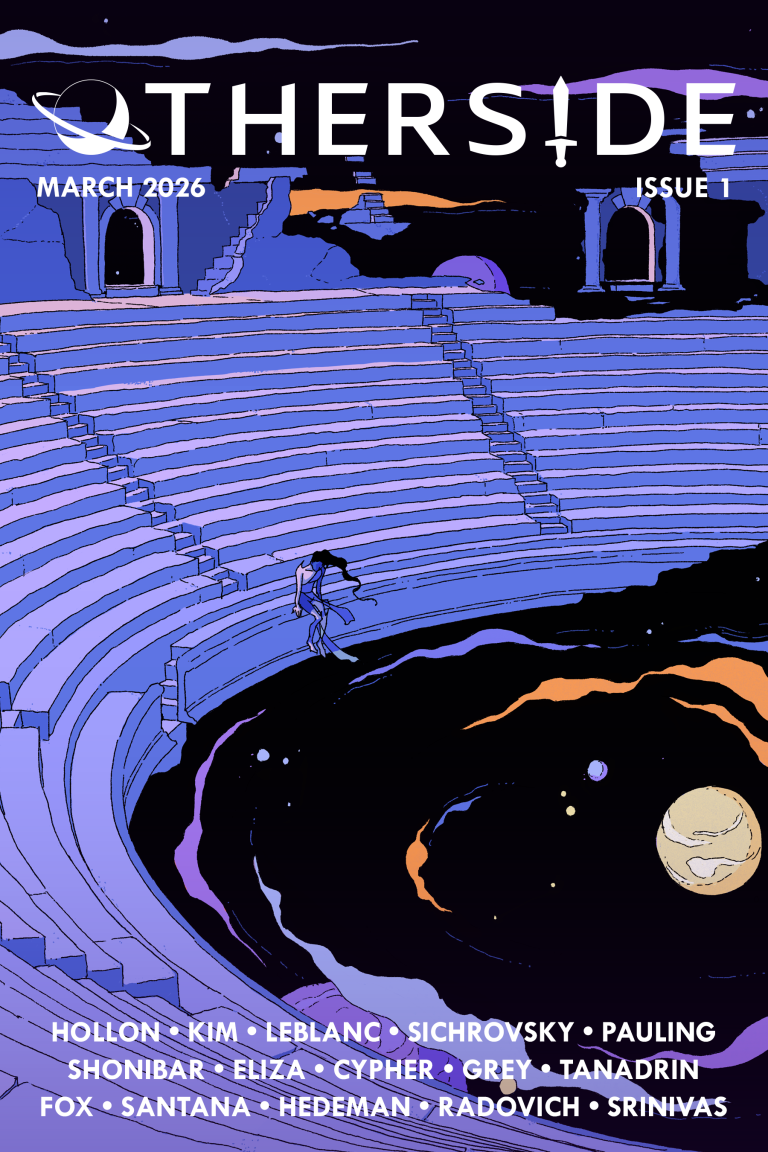

The Vetala of Crystal Vellam Inlet
BY
(
3,568 WORDS
)
In the 668th year after Creation, which was also the fortieth year of the reign of imperator Jadunath, master of sky and stars—may his memory be a curse!—a sorcerer came to the maharaja’s court in search of a wife.
Our lord Manbir of the southern seas was descended from a line of pirate queens. He had an eye for sharp blades, swift boats, and the strength of men’s arms. He admired the sorcerer’s physique and the sorcerer’s clear green eyes and thought to himself that here was a promising recruit.
“Step forward,” he cried, “and speak your desire.”
“There is, at present, a plague troubling Crystal Vellam Inlet,” the sorcerer announced. “This plague will spread and, as prophesied, overwhelm your humble suzerainty. Once I have contained it, I will take for my wife your only daughter.”
As he spoke he made an elegant obeisance.
But the maharaja was roused to breathless fury by the audacity of this demand, and he seized a glittering spear and hurled it at the sorcerer, bellowing at him to be gone.
The spear burst into a cyclone of marigolds that fluttered harmlessly to the ground. By the time the storm had passed, the sorcerer had vanished.

“That could have gone better,” Mayan said to his donkey, brushing marigold fragments from the folds of his dhoti. “Was I rude? Should I have flattered, said ‘glorious empire’ instead of ‘humble suzerainty’?”
The donkey, Parvati, brayed and flicked her tail.
“You’re right,” Mayan said. “I don’t want to marry any woman, let alone a princess, but how else am I to make my name?”
“Gods preserve us!” Mayan saw a villager standing beneath the shadow of a shipbuilding tree. She was chewing betel nut, which stains the mouth, and her saliva flew like droplets of blood. “A talking donkey!”
“Oh, no,” Mayan hastened to reassure her. “She doesn’t talk. I just pretend she does.”
“Gods preserve us,” repeated the villager. “A madman!”
“Perhaps,” said Mayan. “But first and foremost, I am a sorcerer.”
“Then our prayers have been answered,” the villager said. “Come with me!”
“This is Crystal Vellam Inlet?” Mayan had only recently learned the skill of teleportation, and he found it disorienting.
“Its outskirts. We survivors have taken to our houseboats. We dare not wander among the banyans at night. But the sickness stalks us still.” The villager frowned. “Are you truly a sorcerer? You look no older than Urmi’s boy Iravan, and he will be twenty when the monsoons come, if any of us live to see the summer.”
“Magic works in mysterious ways,” said Mayan loftily. “Your king has sent me—” Parvati nickered. “Pay no attention to the donkey. Your king has sent me to free you from this scourge.”
“Manbir is good,” the villager said. “Free us, O Sorcerer, so that Manbir can free us all from the scourge of the imperator. We were hard at work building Manbir’s fleet before the vetala came to Crystal Vellam.”
Wiping her blood-red mouth, she led Mayan and Parvati toward the shore.
Mayan and the betel-chewing villager, Kadambari, found the clustered houseboats of Crystal Vellam in disarray. White-haired Geeta, wife of Madhavan the senior carpenter, had breathed her last overnight, but in the morning she had arisen as usual to grind rice and lentils for idlis. Madhavan stood before her, armed with his builder’s saw, flailing at the muttering crowd.
“Do not touch her,” he was shouting. “Do not take her from me again.”
“Father, please!”
“She lives!”
She did not live. Mayan wrinkled his nose as maggots emerged from Geeta’s green-tinged skin and fell wriggling into her idli batter.
“Father, we must perform the funeral rites, we must burn her before she infects us all.”
“Aardash, you ingrate, I curse the day you were born!”
At this, the carpenter’s guild leapt on their master, roaring. “We have had enough of curses!”
“You see the situation,” Kadambari said grimly.
“Yes,” Mayan said. “There isn’t a moment to lose. To be able to possess a corpse in daylight—the vetala is strong and will only grow stronger.”
“What must we do?”
A maggot blundered over Mayan’s big toe and he snatched his foot away with a shudder. “Bind the husband. Burn the wife. The batter, too, and, for good measure, this boat.”
“It will be as you command.”
“Thank you. Also prepare me three nights’ worth of food and drink.”
Kadambari barked out orders. “Are you going on a journey? Is this vetala the creature of some distant, evil wizard?”
“No, I’m just hungry,” Mayan said. “I haven’t had a proper meal in days. But once I’ve eaten, I will go into the banyan grove and destroy the vetala.”
“I know, I know,” Mayan said to Parvati as they trundled through the deserted village of Crystal Vellam. “Easier said than done.”
He was chattering at Parvati to ease his nerves as they wound deeper and deeper into the black banyan grove. The last glimmers of sunlight were sliding away between the trunks, the trees had grown together into twisted shapes, and clammy creepers tickled the back of his neck. From the corner of his eye, Mayan could see the old cremation grounds, where pyres sat abandoned and bodies lay like bundles of sticks in their shrouds.
Mayan’s insides were squirming with fright. As the darkness grew more oppressive and the jungle air choked his throat, he began to berate himself. Why had he come to Crystal Vellam? Why had he decided to confront the maharaja Manbir himself and make a demand for Manbir’s daughter?
“Idiot!” he said. “You should have stuck to herbal remedies and bachelorhood!”
“Well, you know what they say,” said a reedy voice from above. “Go big or go home.”
Parvati let out a thunderous bray and bolted, throwing Mayan into the mud.
“I don’t think I’ve ever heard anyone say that,” Mayan said carefully.
“Oh,” the voice said. “You’re right. It’s a saying from another time, possibly even another dimension.” From overhead, there came a gurgling chuckle like a gush of blood. “O handsome stranger!” cried the vetala. “Won’t you look at me?”
Trembling, Mayan raised his eyes.
The vetala dangled upside-down in the banyan tree, hanging from a knotted shroud like an overgrown spider. Its hair was unkempt, its eyes black, its tongue long and lolling. It grinned at Mayan with red teeth.
Mayan recoiled: those were not betel stains.
“Who are you,” said the grinning vetala, “and what do you want?”
“Don’t you already know? Can’t you see past, present, and future?”
“Of course,” the vetala said, “but I thought you’d like to make a heroic speech first. Before I kill you.”
“That would be unwise,” Mayan said. “I will talk until dawn, and when the rising sun sears your eyes, I will escape.”
“It is many hours until dawn,” the vetala said, “and you are not particularly eloquent, are you, Mayan the Magician? Son of Padma the Puppeteer and Ishan the Illusionist? Oh, don’t teleport!” The vetala began to weep. Its tears ran upward, against gravity. “Let’s talk! I won’t tear out your throat.”
“Yes,” said Mayan quickly. “Let’s solve this without violence. I challenge you, vetala, to—”
“To a duel of riddles?” The vetala wiped its eyes with broken claws and sniffed. “As in the Kathasaritsagara of Somadeva? Oh, you don’t know what that is, do you, it hasn’t been written yet. Well, no matter. You are nowhere near as learned as the scholar-king Vikrama will be. It would not be fair to either of us.”
“What can I do?” Mayan asked. The upside-down tears of the vetala had touched him, against all reason, against all sense. “How can I end your curse on Crystal Vellam?”
“Find my body,” the vetala said. “Set me free.”
“Certainly,” Mayan said, looking in the direction of the village and its pyres.
“I am not there,” the vetala said. “I do not lie among the village dead.”
“Where, then?”
The vetala hesitated. “I sleep in the sea,” it said finally.
“Where in the sea?”
No longer teary, the vetala laughed with the noise of a thousand chittering insects. “I do not know!”
Our lord Manbir of the southern seas opened his eyes in the night to see a shadow leaning over his daughter’s cradle.
“Look,” Mayan said. “I’m sorry about your daughter. I didn’t know she was just a baby.”
Manbir stared at him with bulging eyes.
“I’ll take your sister, if you have one who is willing and of age,” Mayan continued. “Maybe even a maiden aunt. But what I really need right now, to deal with the plague in Crystal Vellam Inlet, is a small fleet.”
The maharaja hurtled out of bed and tackled the sorcerer to the ground. Since the sorcerer’s first alarming visit, Manbir had consulted the seven wise-women of his kingdom and obtained, on their sagacious advice, a chain of pure silver hammered into links under the full moon, which he now looped around Mayan’s throat to prevent him from teleporting.
“Guards!” he shouted.
“Just one ship!” Mayan wheezed. “A catamaran, a raft, anything you can spare!”
“You will be beheaded at dawn!” yelled the maharaja, as his soldiers dragged Mayan away.
“You’re hopeless,” the vetala said, dangling from the ceiling like a spider. “You need a boat, so you leave a village of boat-builders to pester a maharaja who wants you dead?”
The silver chain was heavy around Mayan’s neck. He lifted his head with effort and looked at the vetala with a sagging mouth.
“The ocean is immense,” he said. “To trawl it, to plumb its depths, we will need the power of a pirate king.”
Hundreds of actual spiders were sharing the ceiling with the vetala, crawling over its blue flesh and in and out of its black eyes.
“We have failed each other,” Mayan said. “This silver that imprisons me will repel your touch. In the morning the maharaja will personally behead me, and you will terrorize Crystal Vellam until there is no one left.”
“Unless…” said the vetala.
“Unless?”
The door of Mayan’s cell fell to pieces. Madhavan the senior carpenter stood above the rubble, green in death, wielding his saw as a warrior wields a spear. Behind him, Mayan’s gaolers lay in an enchanted sleep. Pustules were forming on their cheeks.
“You should not have done this,” said Mayan fearfully. “You have brought plague to the city.”
“It is the city,” the vetala said, “that has brought plague to us. Now go, magician! Your noble Parvati awaits you in the courtyard. Ride with all speed back to Crystal Vellam Inlet. Seek out Iravan, son of Urmi. Not for nothing does his name mean ‘Lord of the Sea.’ He is a born sailor. He will take you to my body.”
“Sorcerer!” cried Kadambari, when Mayan and Parvati appeared on the horizon covered in sweat and froth. “You live! But so does the vetala. It is insatiable. We have burned Geeta; now Madhavan is possessed, but whither he has gone, we do not know.”
“The vetala’s rule of terror is drawing to a close,” said Mayan with a confidence he did not feel. “Kadambari, take this chain of silver from my throat as payment for your services and bring me Iravan, son of Urmi.”
Urmi was in attendance at Kadambari’s elbow, a withered-looking woman with eyes that flashed like lightning at the mention of her son’s name. “Iravan, what do you want with Iravan?”
“I must go to sea. Iravan must take me in his skiff.”
The lord of the sea stepped forward, a dark, handsome man with his mother’s flashing eyes.
Mayan swallowed. “I must have him,” he said. “It has been—do not mind the donkey—it has been prophesied.”
“No!” exclaimed Urmi. “Look at the sky. A storm is coming! Don’t steal my son from me. He’s all I have left.”
Urmi’s husband had died in a raid, Kadambari murmured, weighing the silver chain in her hands, and her daughter Indukala lay sick in bed, no more than a day or two from death.
Urmi cried out in grief. But Iravan smiled at Mayan and said, “Am’ma, I will go.”
Iravan was indeed a sailor of considerable skill. But he and Mayan did not travel far before the storm smashed into the inlet, and it required all of Iravan’s expertise and some of Mayan’s magic to guide them to a cove where they could take shelter from the waves.
“This was a fool’s errand,” Mayan said. “For the first time in history, a vetala has shown less-than-universal knowledge.”
“What do you mean?” said Iravan, recoiling. “You spoke to the creature?”
“Naturally,” Mayan said. “I bested it in a duel of wits, and…” He paused, awaiting a bray of protest, but Parvati was out of earshot.
“And?”
Mayan sighed. The storm was dissipating. In its wake, the waters of the inlet were shining like pale quartz. Iravan too was shining, princely.
“Iravan, I cannot lie to you,” Mayan said. “The vetala took pity on me and told me how to break its curse. But without its body, we are doomed to failure.”
Leaving the cove, they saw that the maharaja’s half-constructed fleet had been reduced to splinters.
“This is a catastrophe,” Iravan groaned. “Without the fleet Manbir will not be able to lift a finger against Jadunath. The imperator’s raids will continue, and my poor sister will be slaughtered in her sickbed.”
“Is she afflicted by the plague?”
Yes, Iravan said. She was unblemished but insensate. “Struck down on the eve of her wedding—it breaks our hearts! She is betrothed to Aardash, you see. The foreman of the carpenters.”
Mayan recalled the brawl aboard Madhavan’s houseboat: Aardash, son of Madhavan, was a grizzled man twice his and Iravan’s age.
“A love match?”
“No,” Iravan admitted. “Our father arranged it before he died. But now…”
“I will save her,” Mayan promised. “I cannot stop the vetala, but I will deliver your sister to her bridegroom alive and well.”
Iravan thanked him again and again. “I suppose a great man, a great sorcerer like you, has a rich and beautiful wife,” he said. “A princess, even, or a queen?”
“No,” said Mayan. “At least, not yet.”
When they climbed aboard Iravan’s houseboat, they found Urmi rending her hair and garments and lamenting. She threw her arms around her son with many exclamations, leaving Mayan to gaze upon her stricken daughter.
As dark and lovely as her brother, Indukala lay as one dead, her hair unkempt, her fingernails long and broken. Her lips were blue as though with cold.
“A sleeping beauty,” Mayan said, entranced.
Over his mother’s head, Iravan looked at him with a frown.
“Foolish, headstrong girl!” cried Urmi. “She refused Aardash, but I cajoled her, I begged her on my knees. I thought I had convinced her to do her duty, but what did she do instead? She took to her bed!”
“Am’ma,” said Iravan gently, “I don’t think Indukala fell ill to spite you.”
“The vetala told me,” Mayan told Iravan, “that the plague is not its doing and that diseases such as these are caused by invisible animals smaller than specks of dust.”
“That is nonsense.” Urmi scrubbed at her tears with bent fingers, a gesture Mayan found both moving and strangely familiar. “I have not forgiven you for taking my son,” she said. “His body is unscathed, but I can see that his mind is enchanted and he will never be the same. I think you are not a sorcerer but a rakshasa, in league with the imperator himself.”
“Am’ma, please,” Iravan hissed. “I have asked him to stay to supper.”
“I will not gainsay my son,” Urmi said, “but in the morning you must leave us, or I will take a cleaver to you myself. Sorcerer or no sorcerer!”
So Mayan passed an uneasy evening, eating the appam and black chickpea stew of a woman he knew would attack him at dawn. Though Iravan sat at his right hand, laughing at his stories and glowing like a star, his anxiety did not subside, and it seemed to him that morning arrived much sooner than he desired, for when he glanced at the horizon during a lull in conversation, he saw that the edge of the sea was ablaze with light.
Urmi snatched up her cleaver. But she did not turn on Mayan. “Gods preserve us,” she cried. “A raiding party!”
“It is larger than a raiding party,” Iravan said. “It is Jadunath himself and all his legions.”
The villagers of Crystal Vellam Inlet rushed above-deck and called to one another across the railings of their houseboats.
“We are pincered between Death’s claws,” Kadambari said to Mayan in a low voice. “On the horizon, red Jadunath fills the sky. Behind us, in the banyans, lurks the vetala and its abhorrent disease. O Sorcerer! Is there nothing you can do?”
“Rally, my brothers!” Iravan said to Aardash and his carpenters. “Take up your saws and hammers. The blow we strike against Jadunath will be nothing but a nail in his foot, but even a nail-hole may fester.”
“Wait!” Mayan took Iravan by the hand. “Brave fellow, strike nothing. Follow the example of your sister and lie as one dead.”
“And die a coward’s death?” Iravan wrenched his hand away. “I would sooner drown.”
“Jadunath does not know you have abandoned the village,” Mayan said. “I will hide your boats from his eyes. He and his legions will sail by, march inland—”
Iravan glowered. “Inland to the maharaja!”
“Inland,” said Mayan, “to the vetala.”
For once, Parvati did not contravene him, and Mayan knew his plan was sound. Over Iravan’s protests, he enveloped the houseboats of Crystal Vellam in heavy illusion. The moon and stars guttered and went out. No light escaped: no breath, no life. In silence the warships of Jadunath went sailing by and were lost to sight.
The silence did not last.
“What is that,” whispered Kadambari. “The wind? A rising storm?”
“It is the vetala,” Mayan said. “Leaping from unburned body to unburned body, deathless and unstoppable.”
“You have loosed one great evil,” Iravan said, “to crush another.”
“I have saved your lives.” Once more, Mayan took Iravan by the hand; this time, Iravan did not pull away. “And I would have you live, Iravan. I must thank the vetala for what she has done.”
“She?”
“Yes,” Mayan said. “Have you not guessed? The spirit of the vetala haunts the banyans, but its body lies here on the sea. The vetala is your sister, Indukala.”
The sun rose. The villagers of Crystal Vellam saw the warships of Jadunath drifting in the bay like toys in a bowl of water: forgotten and purposeless. Jadunath’s raiders lay in scattered lines that stretched up the coast and into the jungle. Some had died of plague; others, it seemed, of fright, and still others from having their throats torn open.
Iravan kept vigil before his sister’s bed, guarding her from the villagers who roared that she must be burned alive.
Dawn had brought a certain rosiness to Indukala’s ashen face. Kneeling, Mayan brushed her cheek.
“Your betrothed, Aardash, has survived the night,” he said. “But I suspect the engagement is at an end: he will not wish to marry a vetala.”
Indukala smiled in her sleep. Behind her blue lips, her teeth were bloody.
“Is that enough to appease you?” Mayan said. “Or is there more? Perhaps you would like to leave Crystal Vellam altogether?”
It seemed to Mayan that Indukala’s chest began to rise and fall.
“As my wife,” he said. Parvati stomped the deck. “Ignore the donkey. Marry me, Indukala.”
Another dripping red smile. In the voice of the vetala, Indukala murmured, “That would be unwise.”
“A vetala’s foresight—”
“A woman’s intuition. Look up.”
Mayan obeyed and saw Urmi and Iravan staring at him with twin expressions of horror. As he met Iravan’s flashing eyes, the lord of the sea bit his lip and turned away.
“Forgive me,” Mayan said, gulping. “But still I ask, will you come away with me?”
“In what capacity?” the vetala mocked him. “As your apprentice?”
“As my teacher,” Mayan said. “And… my sister-in-law, I think.”
Iravan spun around. He caught his mother as she fainted and began to smile.
Tentatively, Mayan smiled back.
“Will you?” he asked.
Iravan nodded.
Indukala opened her eyes.
So it was that the plague of Crystal Vellam Inlet was brought to an end, and some say the effort cost the sorcerer his life, for after the Night of Impenetrable Darkness, when he roiled the sea and roused the banyans to shatter the armies of Jadunath, he was never seen or heard from again. O calamity!
Others say that, his powers exhausted, the sorcerer sailed into the great unknown, taking with him his magical talking donkey, a handsome boatman, and a wise and beautiful vetala. Either way, his story ends here.
Jadunath the imperator limped away, defeated but not vanquished. In the 680th year after Creation, Subhadra, daughter of Manbir, mistress of sky and stars—may she live forever!—ascended the throne of the southern seas. Imbued with the seven virtues, accompanied by seven pirate companions, Subhadra sailed to Jadunath’s stronghold and cut off his head.
But that is a tale for another day.
Copyright © 2026 by Simo Srinivas
